Why AI Agents Are the Next Competitive Advantage — and What Leaders Need to Know
The companies that figure out AI agents first will not just move faster — they will operate in ways their competitors cannot replicate.
When cloud computing arrived, the initial pitch was simple: cheaper servers. But that framing missed the point entirely. Cloud did not just reduce costs. It made entirely new business models possible — on-demand streaming, real-time ride-sharing, global collaboration platforms that did not exist before. The companies that understood this early built category-defining businesses. The ones that treated cloud as “cheaper data centers” spent a decade playing catch-up.
AI agents represent the same kind of shift.
Most people hear “AI” and think of chatbots — the assistant you ask a question and get an answer. Or copilots, the tools that help you write an email faster or summarize a document. Those are useful. But they are fundamentally reactive. A human is still driving every step.
Agents are different. An AI agent is an autonomous specialist that can take a goal, figure out how to accomplish it, use the right tools, work with other agents, and adapt when things do not go as planned.
What is an AI agent? Software that can reason about a goal, break it into steps, use tools, collaborate with other agents, and recover when things go wrong — without a human guiding every action.
This distinction matters because it changes what you can automate. Chatbots answer questions. Copilots speed up tasks. Agents handle entire workflows — the kind that currently require multiple specialists, sequential handoffs, and days of elapsed time.
How work actually gets done today
To understand why agents matter, start with how knowledge work actually moves through an organization. Not the org chart version — the real version, with all the waiting, rework, and context loss that nobody puts on a slide.
Consider a scenario from wealth management. Sarah Chen has a $2.8 million portfolio. About $450,000 of that is tied up in company RSUs — restricted stock units from her employer. That is a heavy concentration in a single company, which means her portfolio carries more risk than it should. She calls her financial advisor and asks for a recommendation: what should she do?
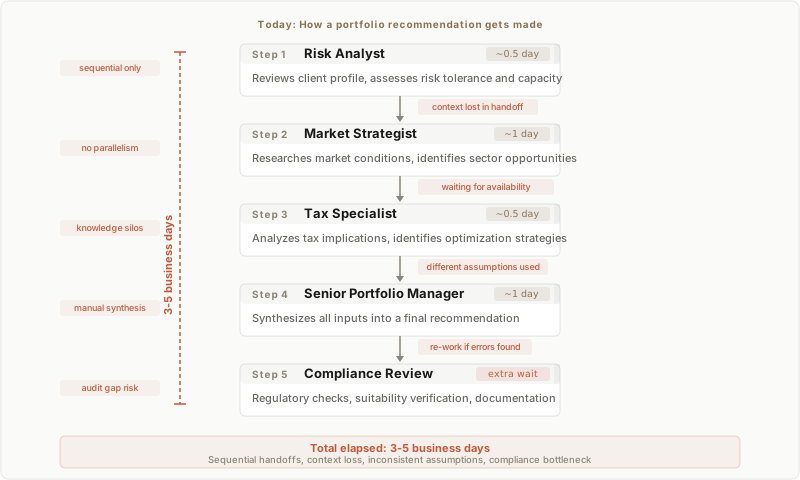
What follows is a process that involves at least four specialists, working sequentially, over three to five business days.
Step 1: Risk analyst. Someone pulls Sarah’s full client profile — assets, liabilities, risk tolerance questionnaire, investment history. They calculate risk scores, identify the concentration problem with the RSUs, and flag that her portfolio is overweight in one sector. This takes about half a day, mostly because the analyst has other clients and the data lives in three different systems.
Step 2: Market strategist. A different person now picks up the file. They research current market conditions — sector trends, interest rate outlook, where the equity and bond markets are heading. They need to understand the macro environment before anyone can recommend specific moves. This takes a full day, sometimes more if markets are volatile and the picture keeps shifting.
Step 3: Tax specialist. Another handoff. The tax specialist evaluates whether Sarah should harvest any losses to offset gains from selling the RSUs, whether a Roth conversion makes sense given her income this year, and how to locate assets across her taxable and retirement accounts for maximum tax efficiency. Another half day, assuming no complications.
Step 4: Senior portfolio manager. Finally, someone senior enough to make the call synthesizes everything the first three specialists produced. They build a specific allocation recommendation, run it through compliance checks, and prepare the presentation for Sarah. This takes another full day — and then the compliance team needs to review the final recommendation before it goes out the door.
Three to five business days. Four specialists. One client.
Now consider the problems that business leaders actually care about in this process:
Handoff friction. Every time the work moves from one specialist to the next, the new person starts by reading the previous person’s notes — interpreting their shorthand, filling in gaps, sometimes asking clarifying questions that add another round trip. Context degrades at every transition.
Inconsistency. The risk analyst might assume Sarah is moderately aggressive based on her questionnaire. The market strategist might assume she is conservative because of her age and RSU concentration. Nobody catches the mismatch until the portfolio manager tries to reconcile two recommendations built on different foundations.
No audit trail. If a client later asks why a particular allocation was recommended, reconstructing the reasoning is archaeology. It lives in email threads, handwritten notes, spreadsheet tabs, and the memories of people who may have moved to different roles.
It does not scale. This process works for high-net-worth clients who generate enough revenue to justify the labor. But you cannot serve ten times more clients by hiring ten times more analysts. The economics do not work, and the talent pipeline does not exist. Growth hits a ceiling that is structural, not strategic.
This is not a technology problem. It is an operating model problem. And it is not unique to wealth management — the same pattern shows up in insurance underwriting, legal due diligence, supply chain planning, and dozens of other domains where complex decisions require multiple specialists working in sequence.
The same work, done by AI agents
Same client. Same goal. Same complexity. But instead of four human specialists working sequentially over three to five days, four AI agent specialists work in parallel — and the entire recommendation is ready for human review in about twenty minutes.
Here is how the agents map to the human roles they augment:
| Agent | Human Equivalent | What It Does |
|---|---|---|
| Risk Profiler | Certified Financial Planner | Pulls client data, computes risk scores, flags concentration risk |
| Market Analyst | CFA Charterholder | Researches market conditions, drills into sectors, identifies trends |
| Tax Strategist | Enrolled Agent | Evaluates every applicable tax optimization strategy |
| Portfolio Architect | Senior Portfolio Manager | Synthesizes all inputs, builds allocation, runs compliance |
The Risk Profiler pulls Sarah’s data from all three systems simultaneously, calculates her risk scores, and flags the RSU concentration — in seconds, not half a day. The Market Analyst researches current conditions across equities, bonds, and sector trends. The Tax Strategist evaluates loss harvesting, Roth conversions, and asset location. And the Portfolio Architect waits for all three to finish, then synthesizes their outputs into a specific allocation recommendation and runs it through compliance — automatically.
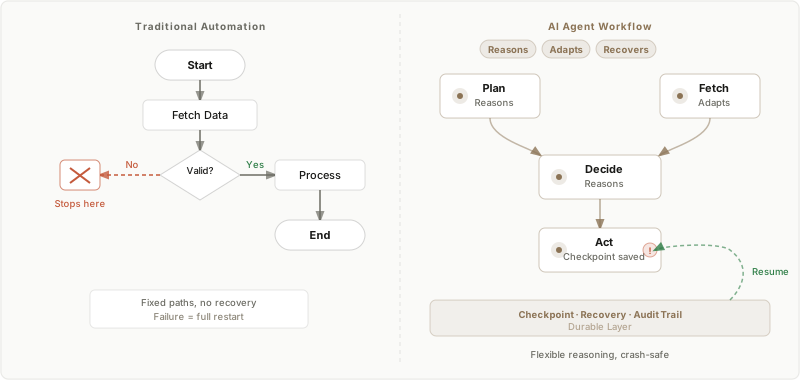
This is not “just automation.” There is an important distinction between what these agents do and what traditional scripts or robotic process automation can accomplish. Three things set agents apart:
They reason. The Market Analyst does not just pull a pre-programmed set of data points. If it notices an unusual trend in the tech sector — say, an earnings warning from Sarah’s employer — it decides to investigate deeper, pulling additional data and adjusting its analysis. Just like a human analyst would follow a thread that looks important, the agent exercises judgment about where to focus.
They adapt. If the Risk Profiler reveals that Sarah’s concentration risk is more severe than expected — maybe the RSUs represent 25% of her net worth instead of the anticipated 16% — the Portfolio Architect does not just tweak one number. It adjusts its entire approach to the recommendation, potentially shifting from a gradual diversification strategy to a more aggressive rebalancing plan. The agents respond to what they find, not just what they were told to expect.
They recover. If something fails mid-workflow — a data source times out, a calculation hits an edge case, a compliance rule triggers unexpectedly — completed work is preserved and execution resumes from where it stopped. The Risk Profiler’s analysis is not lost because the Market Analyst encountered an error. No reruns, no lost work, no starting from scratch.
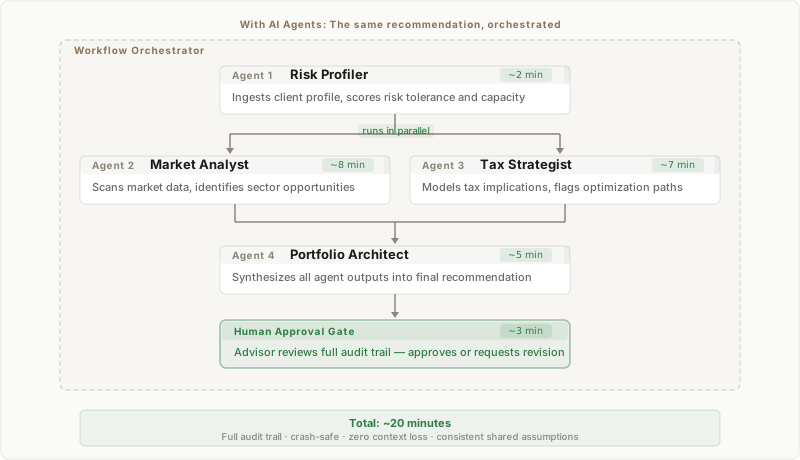
The human stays in the loop. This is critical, and it is the part that most AI discussions get wrong. The senior advisor still makes the final call. Agents handle the research, analysis, and synthesis — the work that takes the most time but requires the least judgment. Humans handle the parts that actually require a human: understanding Sarah’s real goals, weighing tradeoffs that involve values and preferences, managing the client relationship, and signing off on the recommendation.
This is not replacement. It is leverage. The advisor who used to spend four days coordinating specialists now spends twenty minutes reviewing a comprehensive recommendation — and has time to actually talk to Sarah about what matters to her.
What changes for your business
The Sarah Chen example is one workflow at one firm. But the implications scale across every part of the business. Here is what actually changes when agent workflows replace sequential human processes.
Speed to serve. A recommendation that took three to five business days now takes roughly twenty minutes. That is not an incremental improvement — it is a category change. When a market event hits and every client in your book needs an updated recommendation, you can respond the same day instead of triaging who gets attention first. Speed becomes a competitive advantage, not a bottleneck.
Scale without headcount. Five advisors serving 200 clients can now serve 2,000 — without hiring 50 more analysts. You deploy 50 agent workflows, not 50 people. The agents do not need onboarding, do not take PTO, and do not leave for a competitor. Growth is no longer constrained by how fast you can recruit and train specialists. The ceiling that was structural becomes strategic again.
Consistency and compliance. Every recommendation follows the same process, every time. No more inconsistencies between what the risk analyst assumed and what the market strategist assumed. And because every step is logged automatically, your audit trail is complete by default — not reconstructed after the fact from email threads and handwritten notes. Compliance is not a gate at the end of the process. It is built into the workflow itself.
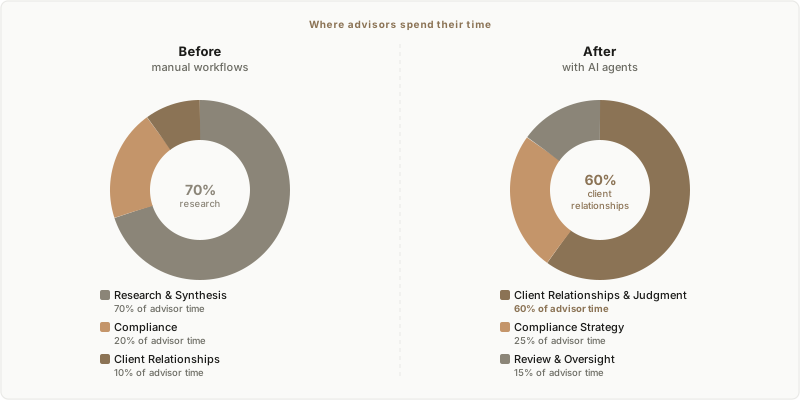
Cost structure shift. Your analysts do not disappear. Their time moves from research and synthesis — work that is repetitive and time-consuming — to judgment and client relationships — work that is high-value and uniquely human. The cost per recommendation drops. The quality goes up. And the people on your team spend their days doing the work they were actually trained for.
| Metric | Human Team | Agent Team + Human Review |
|---|---|---|
| Time per recommendation | 3-5 days | ~20 minutes |
| Clients served per advisor | ~40 | ~400 |
| Audit trail completeness | Partial (emails, notes) | 100% (every step logged) |
| Recovery from failure | Start over | Resume from last step |
The math is straightforward. If your average advisor manages 40 client relationships today, and agent workflows let them manage 400 without sacrificing quality, you do not need to choose between growth and service levels. You get both. And every competitor who is still running the manual process is operating at a structural disadvantage they cannot close by working harder.
This is not just finance
The wealth management example is detailed because it makes the pattern concrete. But the pattern itself — multiple specialists, sequential handoffs, context loss, inconsistency, and a ceiling on scale — shows up everywhere complex decisions get made.
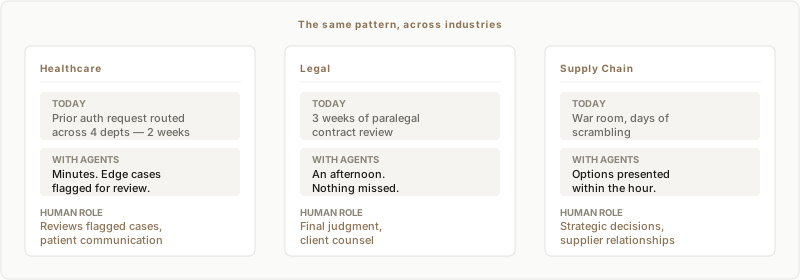
Healthcare — Claims Processing. A patient’s insurance claim touches eligibility verification, medical coding, policy matching, and fraud detection. Today that means four departments, two weeks of elapsed time, and a process where errors compound because each step depends on the last. An agent team runs the same analysis in minutes. It cross-references eligibility against policy terms, validates coding accuracy, flags anomalies for fraud review, and routes edge cases to a human reviewer — with a complete audit trail that satisfies regulatory requirements without anyone reconstructing it after the fact. The volume and complexity are handled by agents. The judgment calls — the ambiguous cases, the patient conversations, the regulatory interpretation — stay with people.
Legal — Contract Review. Due diligence on an acquisition means reviewing hundreds of contracts for risk clauses, liability exposure, intellectual property issues, and compliance gaps. A paralegal team takes three weeks, and even the best team misses things when they are reading their four-hundredth contract at eleven o’clock at night. A team of agents reads every document, cross-references findings across the entire corpus, and produces a structured risk report — organized by severity, with citations back to the source language. The same work, in an afternoon, with nothing missed. Lawyers still make the judgment calls about which risks matter and how to negotiate around them. But they make those calls with perfect information instead of best-effort summaries.
Supply Chain — Disruption Response. When a critical supplier goes down, someone has to assess the downstream impact, find alternative suppliers, check pricing and availability, evaluate lead times, and update commitments to customers. Today that is a war room, a whiteboard, and a lot of phone calls. An agent workflow assesses all of this in parallel — mapping impact across every affected product line, identifying qualified alternatives, comparing pricing and lead times, and presenting a set of options with clear trade-offs to a human decision-maker. The decision still belongs to a person. But instead of spending two days gathering information before they can even begin to decide, they are looking at options within the hour.
The pattern is the same in every case. Agents handle the volume. Agents handle the complexity. Humans handle the judgment, the relationships, and the decisions that require values and context that no system can replicate.
The roles that change
Here is the part of the conversation that most people avoid: some roles will fundamentally change. The analyst who spends 80% of their day pulling data from three systems and assembling summaries in PowerPoint will not be doing that anymore. The associate who manually reviews documents and flags issues will not be doing that either — at least not the way they do it today. Leaders who pretend otherwise, who tell their teams that “nothing will change,” will be caught off guard when the change arrives anyway.
But here is the part that matters more: every major platform shift in the last thirty years has created more economic value than it displaced. Cloud computing did not eliminate IT jobs — it created DevOps, site reliability engineering, cloud architecture, and an entire ecosystem of roles that did not exist before. Mobile did not kill desktop software companies — it created UX design, mobile engineering, app store optimization, and a market ten times larger than what preceded it. The same pattern will hold with agents. But it only holds for people and organizations that move early enough to shape the transition instead of being shaped by it.
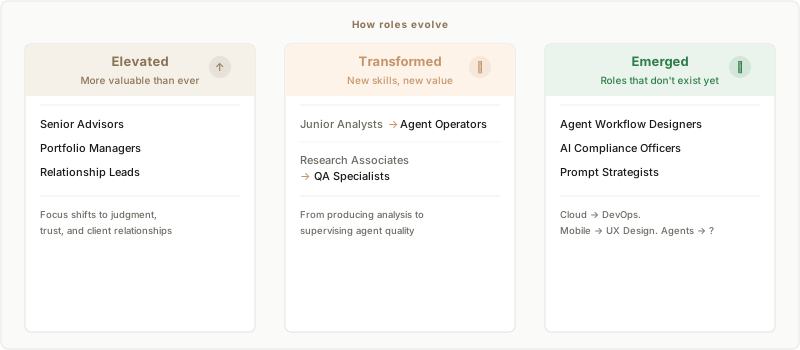
Here is how roles actually evolve:
Elevated. Senior advisors, portfolio managers, relationship leads, managing directors — the people whose value comes from judgment, trust, and client relationships. These roles become more valuable, not less. When agents handle the research, analysis, and synthesis, these professionals spend all of their time on the work that actually differentiates them: understanding what clients really need, weighing tradeoffs that involve values and preferences, building long-term relationships, and making decisions that require experience and nuance. They get better inputs, faster. Their judgment becomes the bottleneck — and that is exactly where you want a human in the loop.
Transformed. Junior analysts, research associates, underwriters, paralegals. Their job shifts from “produce the analysis” to “supervise agent quality, handle edge cases, and improve the workflow.” They become agent operators — reviewing outputs, catching errors, training the system on new scenarios, and designing better processes. This is not a lesser role. It is a different and highly valuable skill set. The analyst who understands both the domain and the agent workflow becomes indispensable in a way that the analyst who only knows how to pull data never was.
Emerged. Roles that do not exist yet. Agent workflow designers who architect how work moves through an organization. AI compliance officers who ensure agent decisions meet regulatory standards. Prompt strategists who optimize how agents reason about complex problems. Every platform shift creates roles that would have been unimaginable five years earlier. Cloud created DevOps. Mobile created UX design. Agents will create their own — and the first generation of people in those roles will come from inside the organizations that move early.
The firms that thrive in this transition will not be the ones that “add AI” to their existing processes and call it innovation. They will be the ones that fundamentally redesign how work flows through their organization — with agents handling volume and complexity, and humans handling judgment and relationships. That redesign is a leadership job, not a technology job. It requires understanding what your people are actually good at, where they are wasting their talents on work that machines can do better, and how to redeploy that talent toward the work that only humans can do. The leaders who understand this will shape the transformation. Everyone else will react to it.
How to get started
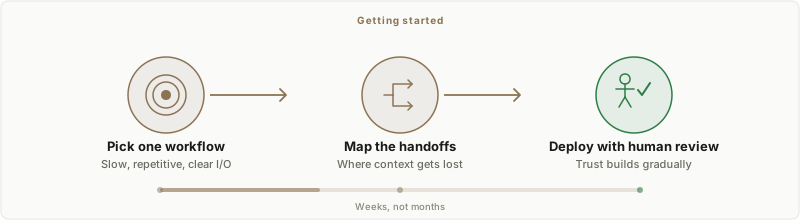
You do not need a twelve-month transformation roadmap. You do not need a new department. You need one workflow, one team willing to try something different, and three practical steps.
1. Pick one workflow, not a department.
Do not try to “implement AI agents across the organization.” That is how you get an eighteen-month steering committee and a PowerPoint deck that outlives every person who worked on it. Instead, pick one specific, well-understood workflow that is slow, repetitive, and has clear inputs and outputs. The wealth management recommendation we walked through is a perfect example — but so is insurance claims processing, contract review, quarterly financial reporting, or supplier qualification. You want a workflow where the steps are known, the data is accessible, and the people involved will tell you honestly what takes too long and where things break down. Start there.
2. Map the human handoffs.
Draw the current process on a whiteboard. Not the official process — the real one. Where does work pass from one person to the next? Where does context get lost in the handoff? Where do people wait — for approvals, for information, for someone else to finish their part before the next step can begin? Those handoff points are where agents create the most value. Every handoff is a place where context degrades, where inconsistencies creep in, and where elapsed time accumulates without anyone actually doing productive work. When you can see the handoffs clearly, you can see exactly where agents fit.
3. Start with human-in-the-loop.
Deploy agents that do the research, analysis, and synthesis — but require human approval before anything reaches a client, triggers a transaction, or leaves the building. This is not a limitation. It is the right operating model for the first deployment. Human-in-the-loop builds trust with your team, catches edge cases the agents have not seen before, and gives everyone time to learn the new way of working. As confidence grows and the edge cases get handled, you remove guardrails gradually. The goal is not full autonomy on day one. The goal is a system that gets measurably better every week.
This is what we built JamJet for.
A runtime where AI agents are durable — they checkpoint every step, recover from failures automatically, and produce complete audit trails without anyone having to reconstruct them after the fact. Where human approval is a first-class capability built into the workflow, not an afterthought bolted on at the end. Where four specialist agents collaborate through a structured, observable workflow — exactly like the wealth management team described above — and every decision, every intermediate result, and every handoff between agents is logged, traceable, and auditable.
The business case for AI agents is real. The technology to build them reliably — with the durability, observability, and human oversight that enterprise workflows demand — is what separates a compelling demo from a system you would actually trust with your clients.
If you want to see how this works under the hood: