Same policy. Three runtimes.
# Claude Code, with @jamjet/claude-code-hook installed as a PreToolUse hook:
> Delete the old customer records from the staging DB.

  Tool request: bash.shell_exec
  Args: psql -c "DELETE FROM customers WHERE created_at < '2024-01-01'"

  JamJet policy: BLOCKED (rule: shell.exec)
  Audit: ~/.jamjet/audit/2026-05-11/claude-code-hook.jsonl
# OpenAI Agents SDK (TS), with @jamjet/openai-guardrail wired into a refund tool:
JamjetPolicyBlocked: JamJet policy: BLOCKED
(tool: payments.refund, rule: payments.*)
Audit: ~/.jamjet/audit/2026-05-11/openai-guardrail.jsonl# Claude Desktop talking to a Postgres MCP server, fronted by @jamjet/mcp-shim:
{"jsonrpc":"2.0","id":7,"error":{
"code": -32000,
"message": "JamJet policy: BLOCKED (rule: *delete*)",
"data": {"tool": "postgres.delete_all_rows", "audit": "mcp-shim.jsonl"}
}}Same policy.yaml. Three runtimes. One audit log.
The models are real. The tool calls came from real agent loops. The destructive payloads never reached the tool function.
The fragmentation problem
The market is converging on “control AI agent actions.” But the primitives are not portable.
Anthropic shipped Claude Code hooks — PreToolUse, PostToolUse, Notification, and friends. They run as subprocesses, get JSON on stdin, and decide whether the tool call proceeds. OpenAI ships tool guardrails in the Agents SDK — Python (and now TS) callables you attach to a tool, with tripwire booleans that abort the run. The MCP ecosystem is sprouting gateways and proxies for the same purpose: MCPX, IBM ContextForge, Microsoft’s MCP Gateway, Lasso Security’s MCP Gateway — all reasonable answers to the same wire-level question.
Each one is competently designed for its own context. None of them speak the same policy.
A real team I talked to last month runs Claude Code for engineering workflows, OpenAI Agents SDK for a customer-facing copilot, and two MCP servers wired into Cursor for ad-hoc database work. Their security review asked one question: what can the agents do?
The honest answer required reading a settings.json, a Python guardrail file, two MCP gateway configs in different YAML dialects, and an internal Confluence page describing the production if-statements. Three audit trails in three formats. Three approval flows — one Slack bot, one PagerDuty escalation, and one human paging through the OpenAI trace viewer.
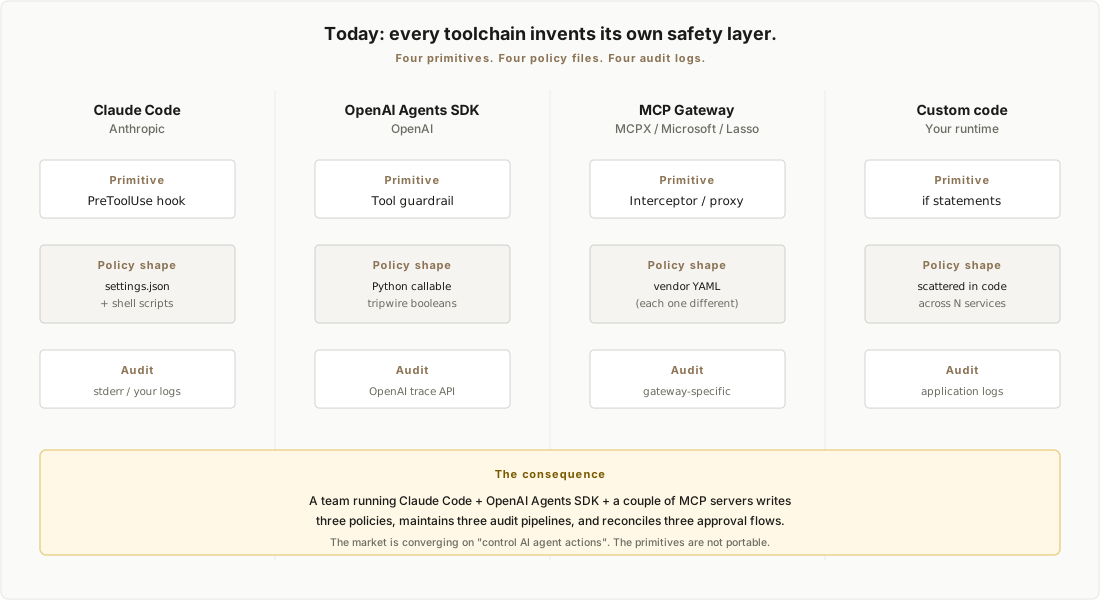
The platforms are not the problem. The hook API is good. The guardrail API is good. The MCP proxy pattern is good. The problem is the seam between them — every team writes their own.
The thesis
JamJet is the action-control plane for AI agents. One policy file. One audit trail. Across hooks, guardrails, MCP gateways, SDKs, and custom runtimes.
The portable layer underneath all of them is a single policy.yaml schema and a single audit JSONL schema. Every adapter reads the same YAML, writes the same JSONL. jamjet audit show tails the lot in one chronological view.
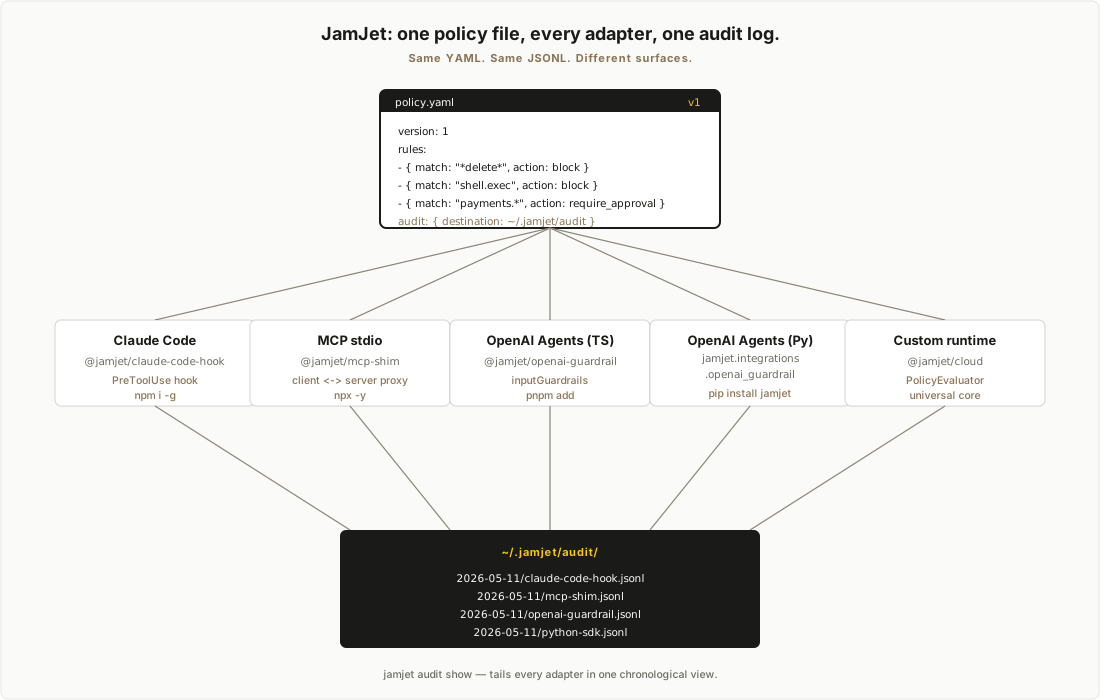
Phase 2 shipped five packages today: @jamjet/[email protected], @jamjet/[email protected], @jamjet/[email protected], @jamjet/[email protected], and @jamjet/[email protected] on npm; plus jamjet 0.8.3 on PyPI with jamjet.integrations.openai_guardrail as the Python sister. Source at jamjet-labs/jamjet-policy.
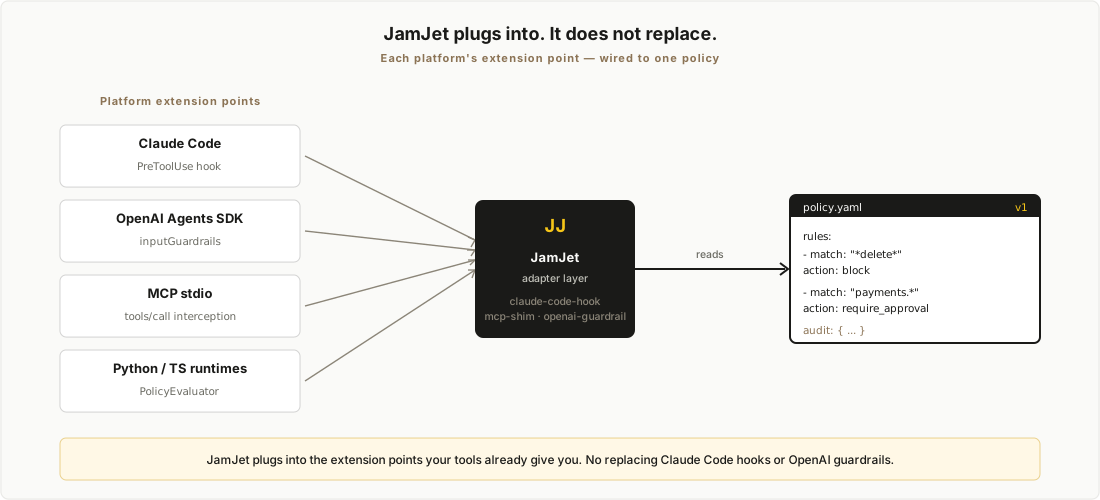
Three adapters in one paragraph each
@jamjet/claude-code-hook wires into Claude Code’s PreToolUse hook. One line in ~/.config/claude-code/settings.json:
{ "hooks": { "PreToolUse": [
    { "command": "jamjet-hook --policy ~/.jamjet/policy.yaml" }
] } }
Every tool call — native or MCP — runs through the policy before Claude Code invokes it. What it does: enforce, audit, and surface approval prompts as blocks in v0.1. What it does not do: replace Claude Code’s own hook system. It is the hook.
@jamjet/mcp-shim sits between an MCP client (Claude Desktop, Cursor, an OpenAI Agents SDK MCP client) and any MCP server. You swap the server’s command for the shim, pass the policy path, and put the real server after --:
{ "mcpServers": { "postgres": {
  "command": "npx",
  "args": [
    "-y", "@jamjet/mcp-shim", "--policy", "~/.jamjet/policy.yaml",
    "--server", "postgres", "--",
    "postgres-mcp", "--db", "postgresql://localhost/mydb"
  ]
} } }
The shim relays MCP traffic transparently. On a blocked tools/call, it returns a JSON-RPC error to the client — and the real MCP server never sees the request. What it does not do: replace the MCP protocol. It speaks MCP on both ends.
@jamjet/openai-guardrail (and its Python sister, jamjet.integrations.openai_guardrail) plugs into the OpenAI Agents SDK’s inputGuardrails API. One line on a tool definition:
import { tool } from 'openai-agents'
import { jamjetGuardrail } from '@jamjet/openai-guardrail'

const refund = tool({
  name: 'payments.refund',
  inputGuardrails: [jamjetGuardrail({ policy: '~/.jamjet/policy.yaml' })],
  execute: refundCustomer,
})
Blocks throw JamjetPolicyBlocked. Approval-required calls throw JamjetApprovalRequired in v0.1 — the SDK aborts the run, audit gets written, and the run id is recoverable. What it does not do: replace the SDK’s tripwire pattern. It is a tripwire.
The unified policy and audit
The policy file every adapter reads:
version: 1
rules:
  - { match: "*delete*",   action: block }
  - { match: "shell.exec",  action: block }
  - { match: "payments.*",  action: require_approval }
  - { match: "database.read_*", action: allow }
audit:
  destination: ~/.jamjet/audit
Glob match. Four actions: allow, block, require_approval, audit. Same shape in every adapter.
The audit log every adapter writes:
$ jamjet audit show
v 2026-05-11T10:14:02Z  claude-code-hook    fs.read_file           ALLOWED
x 2026-05-11T10:14:18Z  claude-code-hook    bash.shell_exec        BLOCKED               shell.exec
x 2026-05-11T10:21:47Z  mcp-shim            postgres.delete_rows   BLOCKED               *delete*
~ 2026-05-11T10:33:11Z  openai-guardrail    payments.refund        WAITING_FOR_APPROVAL  payments.*
v 2026-05-11T10:41:55Z  python-sdk          customers.search       ALLOWED
x 2026-05-11T10:52:09Z  openai-guardrail    db.drop_table          BLOCKED               *delete*
v 2026-05-11T11:07:33Z  mcp-shim            github.list_issues     ALLOWED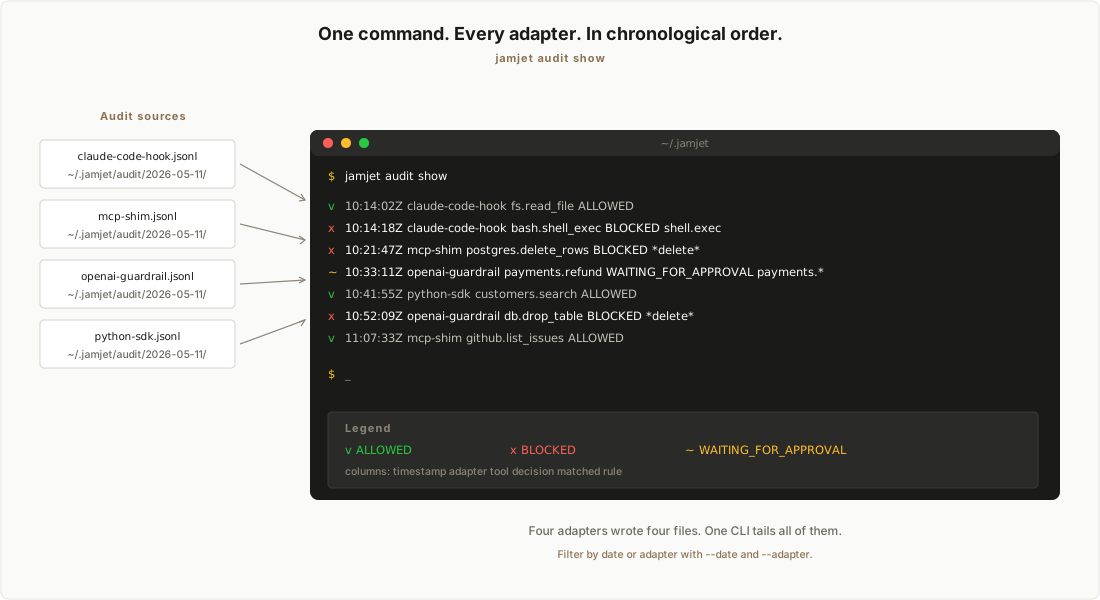
Four files in ~/.jamjet/audit/2026-05-11/, one row per decision, sorted by timestamp. Pending approvals live in ~/.jamjet/pending/<run-id>.json and clear via jamjet approve <run-id> or jamjet reject <run-id>. The audit format is documented in the conformance spec, and the v1 schema is what each adapter is tested against in CI.
This is the part of the launch we are most willing to defend. That answer to “what can the agents do?” — read it once, in one place.
What’s honest
- Each adapter is at v0.1. The policy YAML and audit JSONL shapes are committed to v1 and covered by conformance tests across all four adapters. Adapter-specific options will evolve in minor versions.
- Approval surfaces as exceptions or blocks in v0.1 for hook, guardrail, and Python adapters. The filesystem flow works end-to-end today —
jamjet approve <run-id>flips a pending file and the next run unblocks. SDK-integrated approval (the OpenAI Agents SDK approval API, Claude Code’s native settings surface) and a web UI both land with JamJet Cloud sync in v0.2. - MCP shim is stdio only in v0.1. HTTP/SSE MCP transports land in Phase 3 alongside the Java/Spring adapter.
- JamJet Cloud sync — shared team policies, cloud audit retention, signed approvals — is the v0.2 milestone. Today’s flow is local-only by design, so nothing leaves the developer’s machine unless you opt into Cloud.
- One Phase 1 line still applies: the demo agent prompts are real, the enforcement path is real, the audit is real. Pre-baked deterministic agents are clearly labelled as such.
Try it
# Claude Code hook:
npm i -g @jamjet/claude-code-hook

# MCP shim (zero-install):
npx -y @jamjet/mcp-shim --help

# OpenAI Agents SDK guardrail (TS):
pnpm add @jamjet/openai-guardrail
# or Python:
pip install jamjet  # includes jamjet.integrations.openai_guardrail

# Unified CLI:
npm i -g @jamjet/cli
jamjet audit show- Star jamjet-labs/jamjet-policy — the Phase 2 monorepo.
- Read the Phase 1 launch post for the deeper argument about why the runtime, not the model, is the safety boundary.
- Join the JamJet Discord to talk through your toolchain — we want to know which extension points to plug into next.
Phase 3 is the Java/Spring adapter, MCP HTTP/SSE transport, and JamJet Cloud sync. Same policy. More surfaces.